
How Much Internet Speed Do You Need? Try Our Calculator!
A good internet speed for most households is between 200 and 300 Mbps.
There isn’t a magic formula that can tell you how much internet speed you need. You’ll need to consider several factors specific to how your household uses the internet to determine which capacity works best. But that’s easier said than done if you’re not sure how much bandwidth all your activities need. We’re here to help you demystify what a good internet speed is for your home.
We recommend 200–300 Mbps for the average household. This speed is sufficient to support 2–4 internet users who stream or work from home. Heavy-bandwidth households should aim for 500 Mbps to 1 Gbps plans. Households with basic needs can get by with 100 Mbps internet plans, which is the FCC’s minimum broadband requirement.

Get a $100 Reward Card Offer
Watch: Find Your Perfect Mbps in 2 Minutes
Prefer to listen to our best tips for a good internet speed instead of reading about it? We’ve got you covered with this full explanation on how much internet you need.
What Is a Good Internet Speed?

An internet speed of 200 Mbps is considered fast enough for most households. Generally speaking, faster is always better, but that doesn’t mean more speed is always worth paying for. That’s why 200 Mbps is a good starting point for most internet users. Let’s take a look at some typical internet speeds and what you can expect to get out of them.
| Internet speed | Good for | Number of devices |
|---|---|---|
| 10 Mbps |
|
1–2 |
| 25 Mbps | All of the above, plus:
|
2–3 |
| 100 Mbps | All of the above, plus:
|
3–5 |
| 200 Mbps | All of the above, plus:
|
5–10 |
| 500 Mbps | All of the above, plus:
|
10–15 |
| 1 Gbps (1,000 Mbps) | All of the above, plus:
|
15–30 |
| 2+ Gbps | All of the above, plus:
|
30+ |
Our experts recommend that most households focus on speeds of 200 Mbps and up. For most internet activities, the difference between 10 Mbps and 25 Mbps, or 100 Mbps and 200 Mbps, will be very noticeable.
Experts call relatively fast internet “broadband,” and the Federal Communications Commission (FCC) defines broadband as having download speeds of at least 100 Mbps and upload speeds of at least 20 Mbps.
While the FCC recommends 100 Mbps, we at BroadbandNow find that 200 Mbps is sufficient for most households. With that said, even 200 Mbps may not feel fast by modern standards. For truly speedy performance in higher-bandwidth households, you’ll want to look at options that reach 500 Mbps or higher.
What Is the Difference Between Upload and Download Speed?

If you don’t know the difference between upload and download speeds, here is a simple breakdown:
- Download speed measures how quickly your internet connection can retrieve data from the internet.
- Upload speed is how quickly your internet connection can send data over the internet.
For the typical user, download speed matters much more than upload speed. Lots of things use download speed, such as streaming a movie or loading a website. If your download speed stinks, you’ll notice!
Uploading things happens less often, and it usually involves pretty easy lifting. You don’t need much upload speed to send an email or share a Facebook post, for example.
When you see the advertised speed of an internet plan, it’s usually the download speed. The upload speed may be listed in the fine print. It’s normal for your upload speed to be around one-tenth your download speed, unless you have a fiber internet connection, which will boast symmetrical speeds (upload speeds that are just as fast as download speeds).
What’s a Good Upload Speed?
The speeds listed in the chart above are all download speeds. But what about upload speeds?
The FCC defines broadband internet as having an upload speed of at least 20 Mbps. That should be enough for most consumers. For the typical household, download speeds are much more important than upload speeds. You’ll need a solid download speed to stream content like movies or music, but if you’re engaging in upload-heavy activities such as online gaming or video conferencing, 20 Mbps might not cut it.
That’s why we recommend fiber internet as the gold standard, with symmetrical upload and download speeds that easily handle the uploads you need for gaming, content creation, or working from home. When you upgrade from a cable plan with 20 Mbps upload to a fiber plan with 500 Mbps upload, you’ll be more than pleasantly surprised by the difference.
Ping and Latency: Does It Matter?
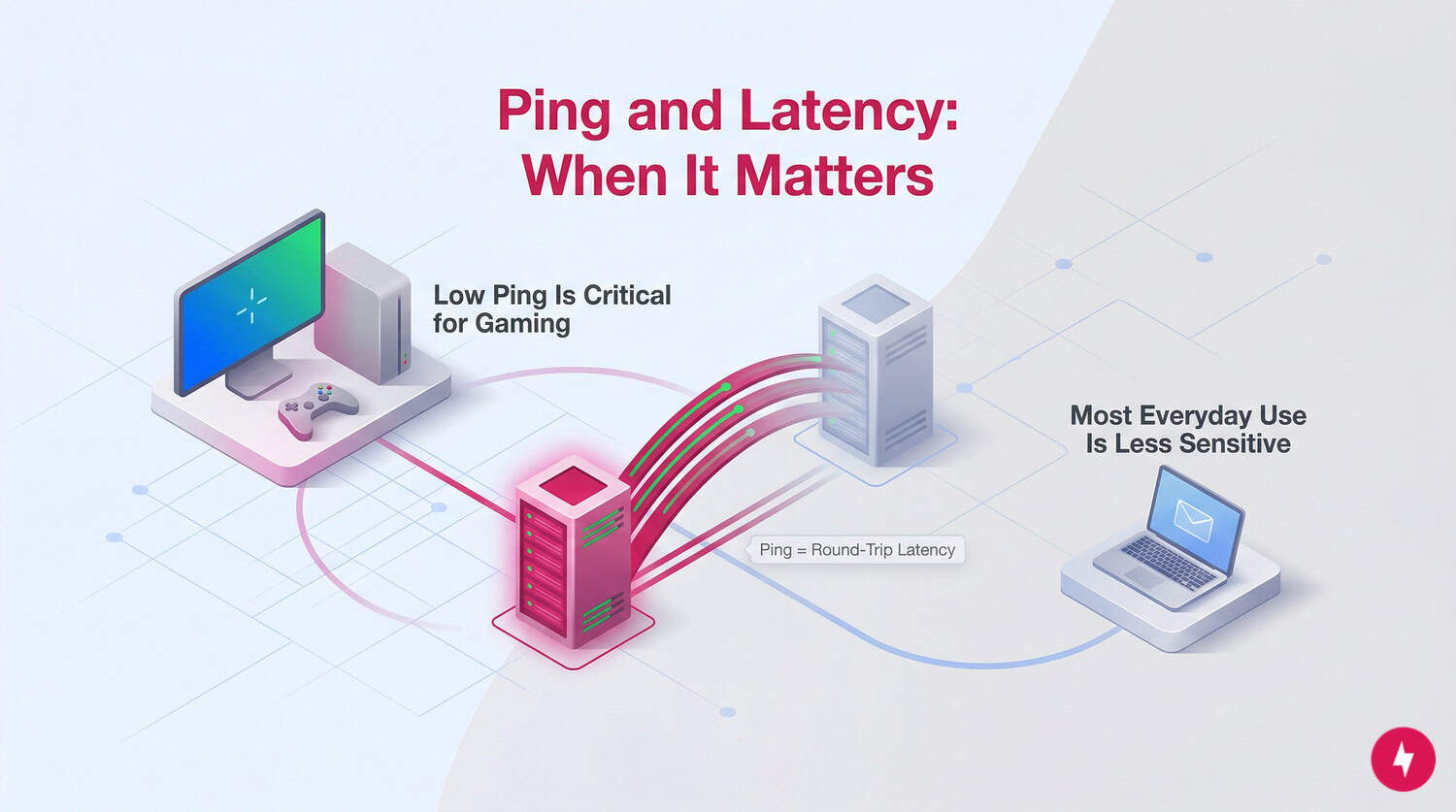
Latency is a measurement of the amount of time it takes for data to be transmitted from one point to another — the lag time between when an action is taken and when it registers on the other end.
“Ping” refers to how long it takes data to get from one place to another and then back again. It gets its name from sonar, the location technology that uses sound to detect echoes. It’s just a way of measuring latency.
But is latency a real concern when deciding which service provider to choose? The short answer is that latency will matter most to gamers, where the back-and-forth ping time can mean the difference between winning and losing. In most other cases, it’s less of a concern.
What About Connection Types? Internet Speeds for Wired Internet
The speed of an internet connection is related, in part, to how that connection works. Those of us who remember the dial-up days know that internet connections used to be relatively slow. The arrival of DSL technology allowed phone-line internet to get a lot faster, and later technologies changed the internet infrastructure itself. Cable internet is delivered over many of the same cables we use for cable TV, and fiber internet uses fiber-optic cables that allow for even faster speeds.
| Internet connection type | Typical speeds offered |
|---|---|
| DSL | 10 to 150 Mbps |
| Cable | 50 Mbps to 2 Gbps (2,000 Mbps) |
| Fiber | 500 Mbps to 5 Gbps |
How Many Mbps Do You Need?

Depending on where you live, you may have access to internet connections as fast as 8 Gbps. Do you really need all of that speed? The short answer is no, and you’ll end up overpaying for speed you could never realistically use. But if you want to figure out exactly how many Mbps you’ll need, you’ll have to think a little bit about how you plan to use the internet. The easiest way to do that is to use the calculator at the top of this page to determine how much internet speed you really need.
When calculating your internet speed needs, there are two big things to consider.
- How will you use the internet? For many households, that includes streaming on-demand video or live TV. That sort of thing will require faster internet than you’d need to simply check your email or update your Facebook status.
- What is the size of your household? Your internet speed isn’t just like a speed limit on a highway. It’s also a bit like the size of a water pipe. A pipe that’s a certain width may be fast enough to deliver good water pressure in your shower, but you’d need a bigger pipe to run two showers at the same time. For the same reason, an internet connection that’s fast enough for Netflix may not be fast enough to handle both Netflix and the YouTube videos the kids are watching upstairs.
Rule of Thumb: Calculate 25–50 Mbps of download speed for each person in your household. For example, a 4-person household would need at least 100–200 Mbps.
What About Gigabit Internet?
Internet connections that can reach up to 1 Gbps are called “gigabit” connections. They’re very impressive, and they can be a great fit for large households with heavy internet usage. (If that sounds like you, check out our guide to the best gigabit internet plans.) With that said, not everyone needs a gigabit plan. Even if you plan to stream lots of movies or play online games, you may find that 250 or 500 Mbps is plenty. Try out our internet speed needs calculator above to see what plan suits you best.
Best Internet Speeds for Streaming
How much internet speed do you need for streaming video? Streaming companies claim the answer is quite low: Netflix recommends a minimum of 3 Mbps for on-demand streaming in standard definition.
In practice, however, most households will find streaming video at 3 Mbps to be very frustrating. We recommend getting at least 15–25 Mbps for basic on-demand streaming. Your experience will improve if you can get 50–100 Mbps. At those speeds, streaming performance will be much more reliable.
Remember: Your total potential speed is split across all of the devices connected to the network. A 25 Mbps plan may provide only 10 to 15 Mbps on Netflix, depending on how many devices are taking a slice. The larger your household, the more speed you should spring for.
As you calculate your bandwidth needs, don’t forget to factor in other activities your household participates in. If you sign up for a 100 Mbps internet plan simply based on streaming needs, but don’t consider one person who works from home while another plays online games, everyone’s speed will suffer.
Best Internet Speed for Gaming
As with streaming, it’s possible to use a relatively slow internet connection to play games online, but you may find that you don’t enjoy the experience much.
Minimum internet speed requirements for gaming are usually 4 to 8 Mbps, but remember that other devices on your network will also be vying for a share of that bandwidth. It’s important to remember that internet speeds naturally fluctuate, so you won’t always get the fastest speed your plan advertises.
If you’re the only one at home, a 200 Mbps internet plan may work for casual gaming. More competitive gamers will want to spring for 300 Mbps or more, and the best internet plans for gaming will reach 500 Mbps or faster and offer symmetrical download and upload speeds.
How Fast Is 200 Mbps?
A 200 Mbps plan is often referred to as the “Goldilocks” of internet plans. It’s neither too fast nor too slow for most households. It provides a reliable balance of speed and affordability, making it ideal for small to medium-sized households with moderate internet usage.
Here are some things you can expect from 200 Mbps:
- Stream Netflix, YouTube, and other platforms in 4K on multiple devices with minimal buffering.
- Play most online games without noticeable lag, even with multiple players.
- Quickly download large files, such as a 5 GB movie, in about seven minutes.
- Browse the web seamlessly with almost zero wait time for loading webpages.
So, is 200 Mbps fast? For a small or medium-sized household with 2–3 devices streaming, gaming, or downloading simultaneously, 200 Mbps is more than sufficient. It’s also a great option if you want to stream in 4K resolution or participate in video calls without interruptions. However, for larger households or those with many connected devices running intensive tasks at once, even 200 Mbps might feel limiting, and higher-speed plans could be worth considering.
Understanding Internet Speed, Bandwidth and Mbps

Want to know more about how internet speeds really work? Let’s dive into the details.
Speed vs. Bandwidth
Speed and bandwidth are two different ways to measure the same basic thing: how fast data can move across your internet connection.
Think of your internet connection as being like your plumbing. Imagine you have water flowing through a pipe. You can measure how fast the water is moving in miles per hour — that’s the speed. But if you also know the pipe’s width, you can figure out how much water is moving through it over a given period of time. We may say a pipe can handle a certain number of gallons per minute. That, essentially, is the pipe’s bandwidth.
For most of us, bandwidth is a much more useful piece of information. That’s why, in practice, we almost never talk about actual internet speed. When most of us talk about internet speed, we actually mean bandwidth: how much information we can move in a given period of time, as measured in Mbps or Gbps.
Mbps vs. Gbps
When we talk about internet speed, we use units such as Mbps and Gbps. What do those terms actually mean?
Remember, what we call “internet speed” is actually bandwidth — the amount of stuff we move in a given period of time. It’s not like the miles per hour of the water in your pipes. Rather, it’s more like the gallons per second.
When we deal with the internet, our gallons become bits of information. Bits are very small, so we group them together. Bits become kilobits and then megabits, just like grams become kilograms or meters become kilometers.
Now we have our “gallons” of information, so we just need our measure of time. That part is simple: We just use seconds. A megabit per second (Mbps) is our measure of bandwidth. For extra-fast speeds, we just go up another level from megabit to gigabit and say gigabits per second (Gbps). One Gbps is about 1,000 Mbps.
Why You’re Not Getting the Speed You’re Paying For

When we talk about internet speed, we typically refer to the speeds listed in plan advertisements. Gigabit plans, for example, advertise up to 1 Gbps. But that “up to” part is very important! In reality, you’ll rarely get internet that’s as fast as what you’re paying for.
What’s my internet speed? Not sure if you’re getting the internet speed you pay for? Use our internet speed test tool to find out for sure.
One reason is that your internet connection only belongs to you for a short distance. Just like your electrical lines or plumbing, your internet cables quickly link up to the larger infrastructure you share with your neighbors. When many people in your area are online, the heavy traffic could slow down your service.
That isn’t the only reason your internet could be slow though. You may need to troubleshoot your Wi-Fi. If your internet seems fast but unreliable, you may need a Wi-Fi extender.
Is Ethernet Faster Than Wi-Fi?
Along with upload speeds, latency and your location, another factor to consider is your Wi-Fi network. The average Wi-Fi speed you experience around your home will generally be anywhere from 20 percent to 50 percent slower than the maximum speed you’re paying for.
That’s because, all things being equal, wired Ethernet connections are faster than Wi-Fi networks. If you connect a device to your router with an Ethernet cable, you’ll experience faster internet speeds than you would with a Wi-Fi connection.
Frequently Asked Questions About Good Internet Speeds
What’s the difference between Mbps and Gbps?
Mbps (Megabits per second) and Gbps (Gigabits per second) measure internet speed. Gigabits are larger than megabits, with 1 Gbps equal to 1,000 Mbps. Most home internet plans advertise speeds in Mbps, while high-speed fiber services often highlight gigabit speeds. For context, downloading a 3–5 MB MP3 song would take seconds at 10 Mbps, while a 4K movie (several GBs) benefits from gigabit speeds for faster downloads. Understanding your usage helps determine if you need Mbps for standard tasks or Gbps for high-speed needs like streaming and large file downloads.
What’s the difference between bits, bytes, MB, and GB?
Bits and bytes measure different aspects of internet use: bits measure speed (e.g., Mbps for Megabits per second), while bytes measure data (e.g., MB or GB). A Megabyte (MB) equals one million bytes, and a Gigabyte (GB) equals one billion bytes. Internet speeds are usually advertised in Mbps, while data usage or caps are in GB. For example, a plan might offer 150 Mbps download speed with a 1,024 GB data cap. Exceeding caps may result in slower speeds or extra charges, depending on the provider’s policy.
Why does internet speed vary by location?
Internet speed varies by location due to differences in infrastructure and distance from central network hubs. Connections like DSL, cable, and fiber rely on nodes or switches to link your home to the wider internet, and the farther your home is from these points, the slower the speed a provider may offer. While one company might have limited speeds in your area, others could offer faster options. To ensure the best service, compare speeds from multiple ISPs before choosing a plan.
What is considered a slow internet speed?
A slow internet speed is generally anything below 100 Mbps for downloads. 100 Mbps is the FCC’s benchmark for broadband. Speeds under this threshold may struggle with streaming, video calls, online gaming, or multiple devices connected at once. If pages load slowly, videos buffer frequently, or connections drop, your speed likely isn’t meeting your household’s needs.
How can I improve my internet speed?
You can improve internet speed by upgrading your plan, placing your router in a central location, and using a modern modem and router. Limiting the number of connected devices, switching to a wired Ethernet connection, and restarting equipment regularly can also help. If issues persist, contact your internet service provider to troubleshoot or explore faster options.